
Students say they can use AI. Employers want proof.
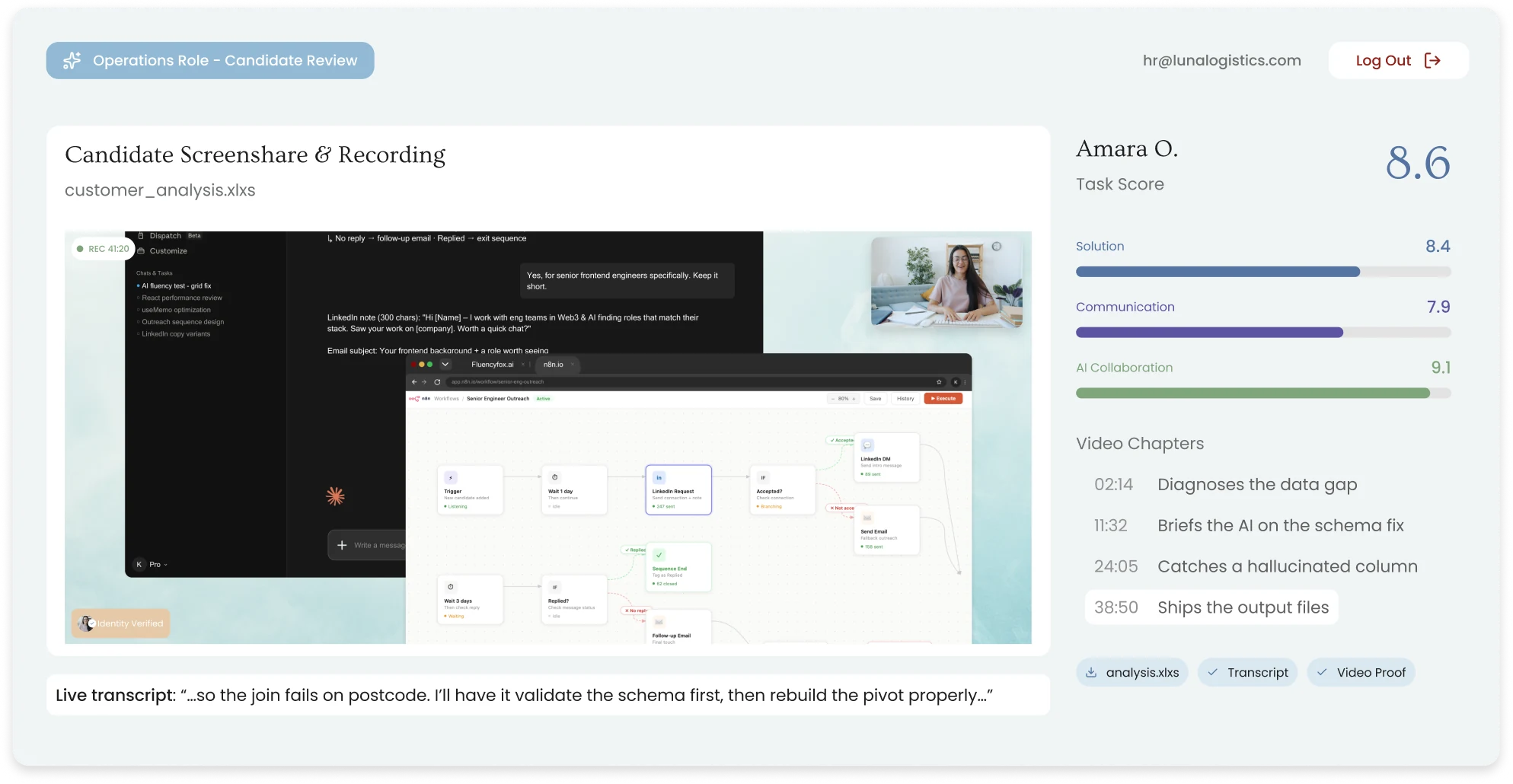
Fluencyfox gives students a real piece of a graduate job to do with AI, a scored report they can show employers, and twelve weeks of training at their level.
AI is part of every graduate job now.
Employers expect it
Graduate employers are changing how they recruit because of AI. They want graduates who can work with it from day one.
They want to see it
When AI can polish any application, employers look for evidence of how someone actually works. A recording of a student doing a real task with AI gives them exactly that.
Students want help with it
Students say AI skills are essential for their future. This gives your team a practical way to build them and show the progress.
What students, employers and your team each get.
| The student | The employer | Your careers team | |
|---|---|---|---|
| Gets | Real work with AI, a scored report, 12 weeks of training | A recording and the work behind every score | A report for every student, and progress over 12 weeks |
| Chooses | Who sees their result | Nothing to set up | Which tasks to offer |
| Costs | Nothing | Nothing | Per student, first ten free |
Sources: Institute of Student Employers, 2025 (redesigning or reviewing recruitment) and HEPI and Kortext, 2026. More in the AI Fluency Data Index.
How it works.
1. A real task, scored
Students do a piece of a graduate job in sales, marketing, finance or operations, using their own AI tools. We record it and score two things: the work they produced, and how they used AI.
2. Training at their level
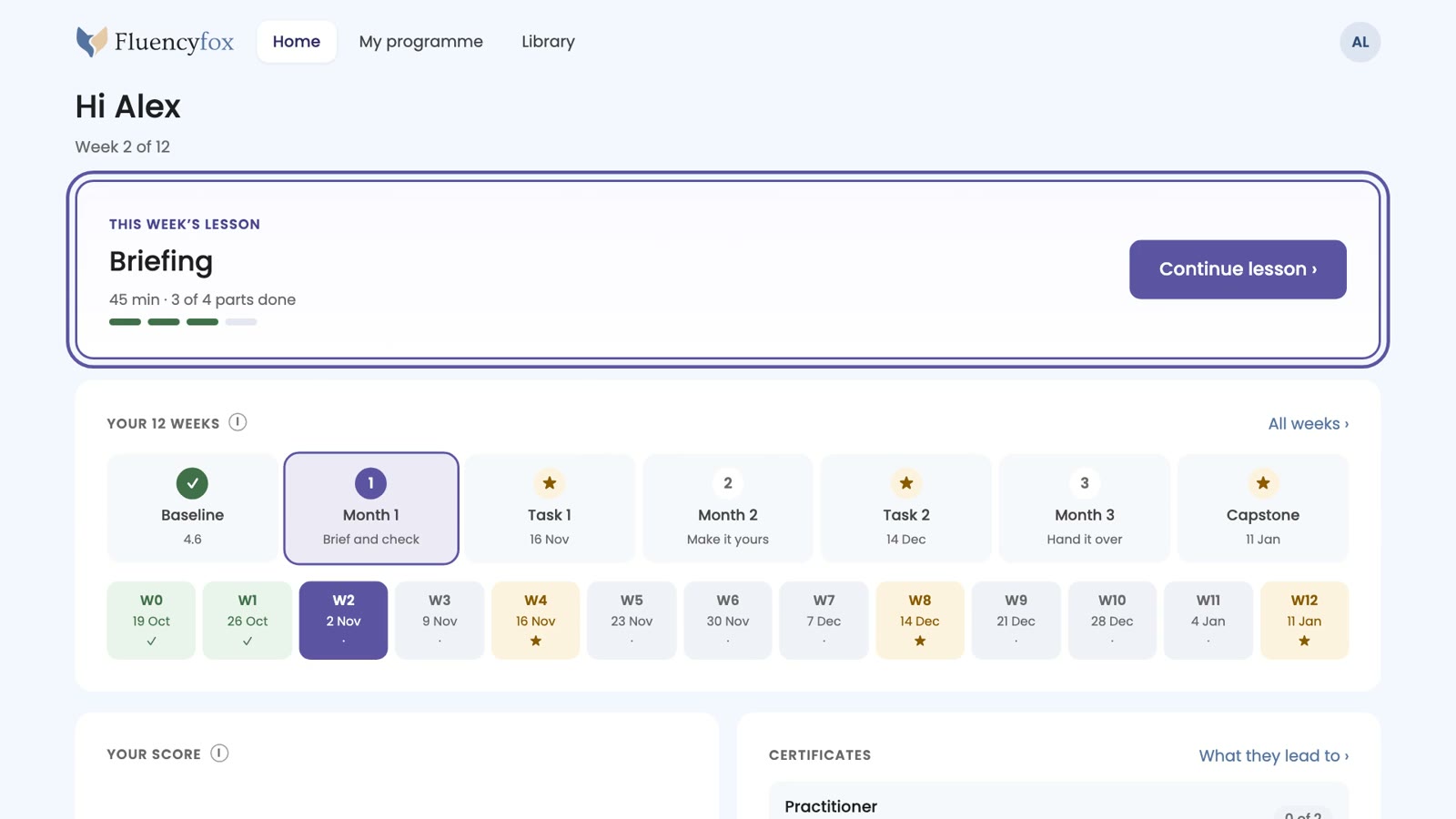
Twelve weeks in Fluencyfox Learn, set by each student’s first score. One lesson a week, around 45 minutes, in their own time. Every lesson ends with a real task and feedback on it.
3. Progress they can show
A new task each month at the same level. By the end each student has four scores and a report that shows how they improved, which they can show an employer.
“The test was unique and unlike anything I have ever had to do for job applications. It was a very fun experience.”
Jay Cushen
Candidate
What students get.
Work experience with AI
A real piece of a graduate job, done the way they’d do it at work. Free AI tools work just as well as paid ones.
Something to show employers
A report with the recording and the work behind every score. They choose who sees it, and get one retake.
A plan to get better
Lessons set by their own score, with certificates as they go.
The same test employers use.
Employers use it to hire and train their teams
Start-ups and scale-ups use Fluencyfox to assess graduate applicants and to train their own people in Fluencyfox Learn, the same programme your students get.
Live with theInterna
Students on theInterna, the internship platform, can take the test from their profile and choose whether employers see the result.
Questions careers teams ask.
Isn’t using AI in an assessment cheating?
No. The jobs students are going into expect them to use AI. We score how well they use it, so a student who pastes in the brief and hands back whatever comes out scores low.
Does it work for arts and humanities students?
Yes. The tasks come from roles like marketing, comms, sales and HR, and students pick the one that suits them. Nobody has to write code.
Do students need a paid AI subscription?
No. Free versions of ChatGPT, Claude, Copilot and others work just as well.
How do students get access?
We give you a link. Share it on your careers portal, in a module or by email.
Who sees the results?
Your team sees each student’s report. Each student decides whether employers see their result. We agree the details with you before anyone starts.
How long does it take?
The task takes as long as that piece of work would, and students do it when it suits them, on a laptop with a camera and microphone. The training runs for 12 weeks, about 45 minutes a week.
What does it cost?
It’s priced per student on a quarterly or yearly plan. Your first ten are free, and from there we’ll build a package around your needs on a call. Check out our pricing here.
Where is student data held?
In the EU, under our privacy policy. Nothing is used to train AI models, and nothing reads faces or emotion. Our privacy policy has the detail.

Try it with ten students, free.
Half an hour to see a real session. Then share a link with ten students and see their reports before you pay anything.
Try it free